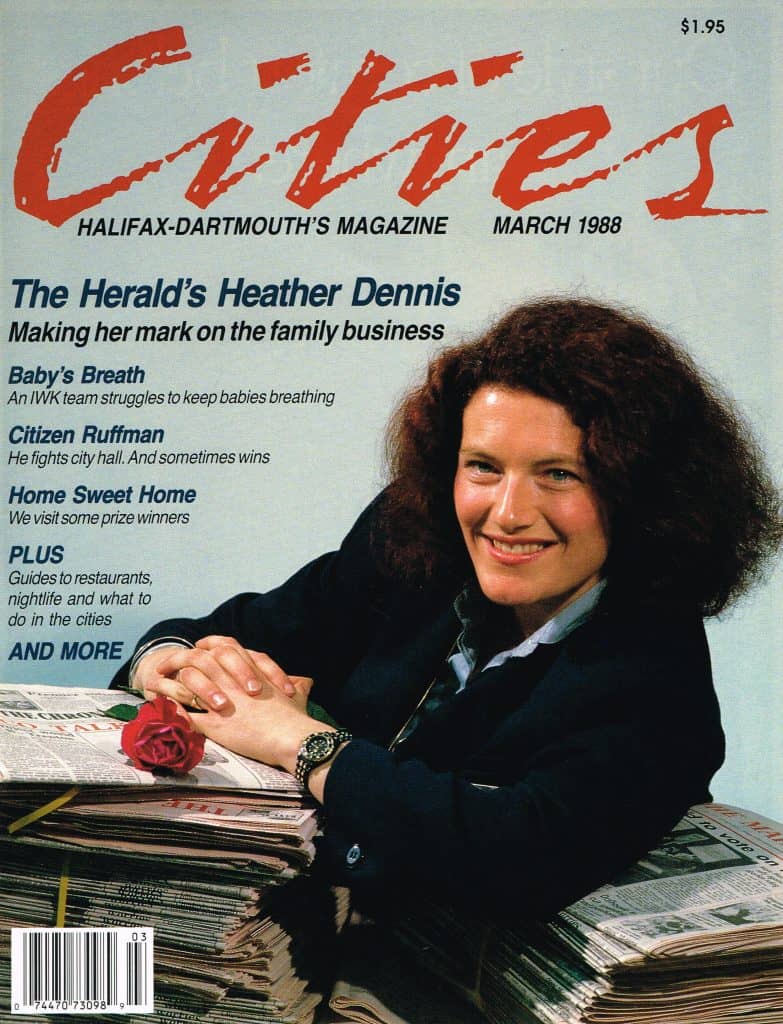
After nearly a decade of self-imposed exile, Heather Dennis returned to her family’s newspaper business in the mid-1980s with plans to turn the Mail-Star into a newspaper people would want to read. Her supporters said she was “a breath of fresh air.” Her detractors wished she’d go away and leave them alone.
From Cities Magazine, March 1988
“The new Mail-Star …” Heather Dennis stops, suddenly aware I’m taking notes. Mentally, she edits her words, conscious that subtle, unintended inferences might be read into them by people outside — but especially inside — the confines of the Halifax Herald Ltd. The image she wants to convey is of a new Halifax Mail-Star — urbane, sophisticated, in tune with the under-35 newspaper reader. But she knows if she plays up that notion, some veteran employees, who, after all, are responsible for the old newspaper — the one that is, by implication, less urbane, less sophisticated, less connected to the under-35 reader — may interpret her words as a personal attack.
Heather Dennis knows some of them hope she will make some fatal misstep that will undercut her growing power and influence at the newspapers. So far, they’ve had to hold their tongues and bide their time. She is, after all, the publisher’s daughter and the changes she is making have Graham Dennis’s blessing. But if this interview turns out badly, for example, and the story ends up being yet another critical piece about the Dennis family newspapers, Heather Dennis knows “there’ll be people who’ll say, ‘I told you so.’ I’m sure there’s a few people here who figure, ‘Okay, let her go ahead and do the interview. She’ll get burned and that’ll teach her.’”
This interview, in fact, represents an especially dangerous gamble. Her father rarely grants interviews to reporters, and the Herald has prided itself on operating as a closed — and closed-mouthed — shop where everyone knows better than to discuss internal affairs with outsiders. Making this gamble even riskier, I’ve written critically about both the Herald and the Dennis family in the past.
“You haven’t exactly been a friend to the paper, or to my family,” she says bluntly when I ask for an interview. She mentions a story I wrote more than a decade earlier, at a time when she’d decided to quit journalism to take up competitive horse jumping. “That,” she says sharply, “wasn’t a very nice story.” But then she laughs. It is an open, easy laugh that seems designed to put me on notice that — while she knows and remembers — she doesn’t hold a grudge.
And eventually, she does agree to an interview. “I don’t have anything to hide,” she says. “Besides, I think it’s time we told people about all the exciting things that are going on here.” That’s why, on this late winter afternoon, Heather Dennis is sitting in her corner office on the second floor of the Herald building, picking her way through a minefield of dangerous words in search of one that won’t blow up in her face.
“‘New’ isn’t really the right word,” she says finally. “What’s the word I’m looking for? Improved? Enhanced? Enhanced! That’s it! When people look at the enhanced Mail-Star, they’ll see it’s a different paper.”
After decades of being little more than a pale imitation of its more influential sister, the morning provincial Chronicle-Herald, the afternoon Mail-Star is getting a major facelift. In part, the physical changes — which include redesigning the front page, introducing a new typeface, experimenting with flashier graphics and more creative use of photos, even hiring a graphic designer in the newsroom for the first time — are intended to make it clear to readers the two papers really are different. But the changes are also intended to signal something else as well. The Mail Star wants to attract a new generation of younger, more sophisticated, urban readers — readers who have, until now, dismissed it as irrelevant and uninteresting.
“The ideal Herald reader,” Heather Dennis explains, “is someone in Truro or Yarmouth who’s interested in provincial news and in national and international news. The Herald is their main source of information and it serves them well. We don’t plan to tamper with that. But the situation in Halifax- Dartmouth — the Mail-Star’s market — is very different,” she notes, warming to a subject that has been the focus of most of her energies since she returned to the family newspaper business 18 months ago.
“We’re dealing with a very sophisticated audience,” she says. “They have access to all kinds of newspapers, television, videos, radio, magazines, you name it. They tend to be transient — lots of them have lived in other cities and have read different newspapers. What they want — and what we’re going to give them — is a different paper than the Mail-Star has been.”
There will be, she says, more columns, more in-depth reporting, more emphasis on social issues. “We want to do stories you can learn from, stories you can empathize with and even some stories that will just make you giggle. It’s going to be a newspaper for people under 35, people like me who grew up with all sorts of media.”
Just as she’s careful not to offend those responsible for the paper as it is, Dennis is equally careful not to imply she’s making these changes herself. That’s one reason she’s invited Jane Purves to join us. Purves, one of the Herald’s brightest lights, is currently news editor of the Chronicle-Herald but she’ll soon become the new afternoon paper’s editorial point person. “I’m not sure what my title is going to be,” Purves allows, “but my job will be making the editorial work.”
Purves, Dennis has already told me, is a key member of an emerging group of aggressive young reporters and editors — many of them women — who are assuming key positions in the newsroom. Although she says she doesn’t want to single any of them out for fear of “missing someone who should be there,“ she mentions at one point or another reporters Michael Doyle, Elissa Barnard and Rob Mills, Business Editor Brian Ward, Social Editor Nancy MacDonald, Entertainment Editor Eleanor Gray, Living Today Editor Margaret MacKay and Out and About Editor Bev Dauphinee as all being part of the “creative team” that’s reshaping the newspaper. “It really is a team,” she emphasizes. “Everyone is involved — the composing room, advertising, promotion, editorial, everyone.”
Heather Dennis is the most important member of that team. Until she arrived, younger employees, frustrated by the newspaper’s old-fashioned, small “c” conservative approach to the world had little influence on the decision-making process.
“The people in power here were basically a bunch of middle-aged guys who’d come to work at the Herald as copy boys when they were 16 and never left,” says one reporter. “They based all their decisions on what they thought Mr. Dennis would want. They thought — wrongly I think now — that Mr. Dennis didn’t want the paper to do anything new or interesting, so they stifled everyone else’s initiative.” Heather Dennis’s arrival, says the reporter, “has been like a breath of fresh air around here. She’s made a lot of people realize the real problem here may never have been Mr. Dennis at all, but the people around him, who tried to anticipate what he wanted.”
Adds an editor: “A lot of the stuff Heather has accomplished here — sectionalizing the paper [developing separate, stand-alone sections for entertainment, lifestyles, etc.] and getting ads squared off [using a more modular approach to laying out the paper] — are things a lot of us have been trying to convince them to do for years. But we always ran into this brick wall. ‘That’s the way we’ve always done it,’ they said. Well, that wasn’t good enough for Heather. She wanted to know why.”
Heather Dennis has become the spokesperson for this new generation of employees. “I’m the monkey in the middle,” she jokes. “I have good communication with my father and the people around him, but I also have good rapport with other people who work here. I think everyone is getting to trust me more. The result is we’re really starting to work as a unit for the benefit of the paper as a whole.”
When Heather Dennis’s new-look Mail-Star finally debuts early next month, it will represent more than just a major visual and editorial makeover at the cities’ largest newspaper. Someday, in fact, it may be seen as having been the symbolic starting point of a new era at the newspaper, the beginning of an orderly transition from the third to the fourth generation of Dennis control of the province’s oldest, largest and most important daily newspapers.
The first newspapering Dennis was Heather’s great-great uncle, a British-born “live-wire” named William Dennis who helped found the Halifax Morning Herald in 1875. By 1907, he owned both that paper and the afternoon Evening Mail. His nephew, William Henry Dennis, whom a contemporary described as “a bullying, aggressive, pushy, smart businessman,” made the Dennis newspapers dominant in Nova Scotia during the 1930s and ’40s.
But the Herald’s business success ultimately became its journalistic undoing. After swallowing its last rivals in 1949, it became what Nova Scotia novelist Thomas Raddall described as a “monolith… on a new monotonous course, with much attention to filler and a spotty attention to hard news.”
The newspapers’ problems were exacerbated in 1954 when William Dennis died suddenly, leaving the newspapers to his son, Graham. Although the inexperienced 26-year-old became owner in name, he willingly ceded real control to his father’s friend, Gordon Daley, a corporate lawyer who remained company president until he died in 1969.
By the time Graham Dennis began to exert his authority at the newspapers in the late sixties, the world view of newspapers in general and the Herald in particular was skeptical.
In 1970, a special Senate Committee on the Mass Media publicly concluded “there is probably no large Canadian city that is so badly served by its newspapers [as Halifax]’” In 1977, the newspaper came under fire again when it dismissed 10 reporters and editors during a union organizing drive. Although it later reinstated them, the resulting trauma created serious, long-term morale problems.
To complicate matters, in 1980 the Herald suddenly found itself facing direct competition again when a feisty new tabloid, the Daily News, began publishing in Halifax. Competition intensified in 1985 when well-heeled Newfoundland Capital Corporation bought the Daily News and installed a new editorial and management team. Their mandate is to convince a broad cross-section of local readers there really is an alternative to what some critics call “the old women of Argyle Street.”
Suddenly, after nearly four decades of having the cities’ daily newspaper market to itself, the Herald seemed not only staid and out-of-date, but possibly even vulnerable too.
Heather Dennis’s decision to return to the family newspapers in the fall of 1986, however, had very little to do with the Herald’s troubles and almost everything to do with her own. “It was a very unhappy period in my life,” she concedes today. “My father knew I was unhappy, but he didn’t push. He’s like a guide for me at times. He’ll let me go along and if he thinks I’m just wandering aimlessly in a fog, he’ll plant a seed and stick me in the sunlight. That’s what he did in this case. He said, ‘Heather, you’re hiding your light under a rock. You should do something with your life.’ He never mentioned the paper directly, but it was there. Finally, we agreed I’d come back and try it for a year. After I was here a while, it was like I’d finally discovered my mission.”
It’s the mission her father always hoped she would take on, but there were certainly moments when he doubted she would. It sometimes seemed Heather Dennis would prefer to do almost anything except work at the family business.
Although clearly to the manor born, Heather Dennis’s childhood was anything but sheltered and genteel. She was just three years old when her mother died of cancer in 1959. That traumatic event ultimately helped forge a special bond between father and daughter, but it also resulted in an unsettled, unsettling childhood.
She was raised partly by live-in help and partly by family friends she lived with during the summers while her father worked, but Dennis insists her childhood was happy — “I didn’t realize that my life was different than anyone else’s” — and even credits her upbringing with making her open to new people and situations and giving her a strong sense of independence. Although she says her father’s remarriage in 1969 when she was 13 resulted in “an adjustment in lifestyle for me,” Dennis is quick to add, “I accepted my stepmother as my mother from the beginning, and I was excited later to have a brother and sister.”
She was less excited about school. After leaving Queen Elizabeth High School after grade eleven, she spent a semester at Saint Mary’s University, “studying Partying 101,” she jokes today, then tried Toronto’s York University for two months before returning home, “outrageously unhappy. I’d been able to get by in high school without much work and I’d never learned to study, so when I came up against something that required concentration and discipline, I flew the coop.”
More to put in time than from any real interest in the family business, Dennis briefly became a reporter at her father’s newspapers. Although she liked being a journalist — she covered the courts — that she was the publisher’s daughter intimidated some of her superiors. “I got very little direction or criticism from anyone,” she says now, “and I was never sure whether people were responding to me as me, or to the fact I was Graham Dennis’s daughter.”
Partly to escape that, Dennis moved to England in 1976 to work with correspondent Michael Cope in the paper’s London bureau. A year later, she gave up newspapering altogether to become an equestrian. “I’d ridden as a kid but it wasn’t very serious until I was in England,“ she says.
If her father was disappointed by her decision, she says, he took pains to hide it. Perhaps because he’d been thrust into the unwelcome role of newspaper publisher at such an early age himself, “he realized I was still young and that it was good for me to get away and do other things.”
After a year in England learning to ride competitively, Dennis moved to the U.S. in 1978 to compete seriously on the North American horse jumping circuit. By the early 1980s, she was among the top 10 riders in North America in “eventing” — a horse jumping endurance competition that combines dressage and show jumping with cross-country racing — and seemed a cinch to make Canada’s 1984 Olympic equestrian team. But then in 1983, her horse suffered a serious fall during a competition. Although Dennis was only shaken up, “the horse developed problems” and wasn’t able to compete again.
That was the end of Dennis’ Olympic dream. Devastated, she and her husband — an American horseman she’d met on the circuit — returned to the Nova Scotia horse-breeding farm they’d bought in 1981. But, Dennis says, “I couldn’t even bring myself to go near the barn. I spent a long time feeling sorry for myself.”
Although she eventually did resume riding and even trained in another jumping event, she admits it was never the same again. At about the same time, her four-year-old marriage fell apart and there was “a kind of domino effect. I wasn’t enjoying riding anymore, my husband and I split up and I was trying to run the farm myself. It was tremendously draining. That’s when I decided I should give the paper another try.”
She hasn’t regretted it for a moment. Although she is officially called the newspapers’ assistant marketing director and works out of a corner office next to the advertising department, her influence has been felt at virtually every level of the newspaper — from broad publishing decisions, such as the one last year to create a series of new daily sections focusing on specific subjects, to nitty-gritty editorial decisions, such as the one to send a reporter and photographer to Ethiopia this winter to report on conditions there two years after the famine became world news.
On the afternoon we meet, in fact, reporter Rob Mills and photographer Len Wagg are flying to Ethiopia. Dennis is professionally proud the newspaper is sending its own people to cover the story, but she is even more pleased personally to discover a note Wagg had left on her desk before he left, thanking her for “putting yourself on the line on this one.”
Dennis has spent a good deal of the past 18 months putting herself on the line, especially with the paper’s middle managers. “There have been a few shouting matches,” suggests one editor, who says Dennis’s victories must be understood in the context of the Herald itself. “At most papers, the changes Heather has brought about —like creating special sections — are no big deal. Here, they’ve been revolutionary. She’s a torpedo through middle management complacency. And she has the clout to make things happen, so a lot of comfortable middle management people hope she’ll get tired of all of this soon, and go away and clip her coupons and leave them alone.”
That’s unlikely. “I really do see this place as a kind of mission,” Dennis says. “It’s a challenge that keeps my interest because it changes so much every day. You can never be bored.”
The question of whether Heather Dennis will succeed her father as publisher is open. Graham Dennis, 60, is still a hands-on publisher who calls the newsroom every night to check on what’s in the next morning’s edition. By the time he’s ready to retire, his two children from his second marriage — a teenaged son and daughter — may also be involved in the papers, and be rivals for the top job.
Dennis professes not to care. “My father and I have a very good working relationship,” she says, “so titles don’t really matter. What I’d like my presence to do is give him the freedom to do the things he never got a chance to do when he was younger because he had to run the newspapers at such an early age. But I don’t expect him to retire. The papers are too important to him for that.”
The newspapers are important to Heather Dennis now as well. That pleases her father. And it may soon please cities’ newspaper readers too.
***
Postscript: Heather Dennis left the newspaper in 1989, frustrated, she says now, “by the people dad had advising him,” and ultimately, by her father himself. “I saw myself as a change agent, as someone who brought together people from all departments to redesign the newspaper. My father was more of a divide-and-conquer kind of manager who would never say yes or no directly. We never had a meeting about issues. Instead, there’d be the cold shoulder, the silent treatment. You got the message.” Dennis continued to write a column for the paper for several years after she resigned from management, but the paper dropped it after a plagiarism incident.


 STEPHEN KIMBER, a Professor of Journalism at the University of King's College in Halifax and co-founder of its MFA in Creative Nonfiction Program, is an award-winning writer, editor and broadcaster. He is the author of two novels and eight non-fiction books. Buy his books


An old friend of Heather’s. I haven’t seen her since 1976, in Kingston, but would like to say hi.
Please pass on my e-address to her.
thanks