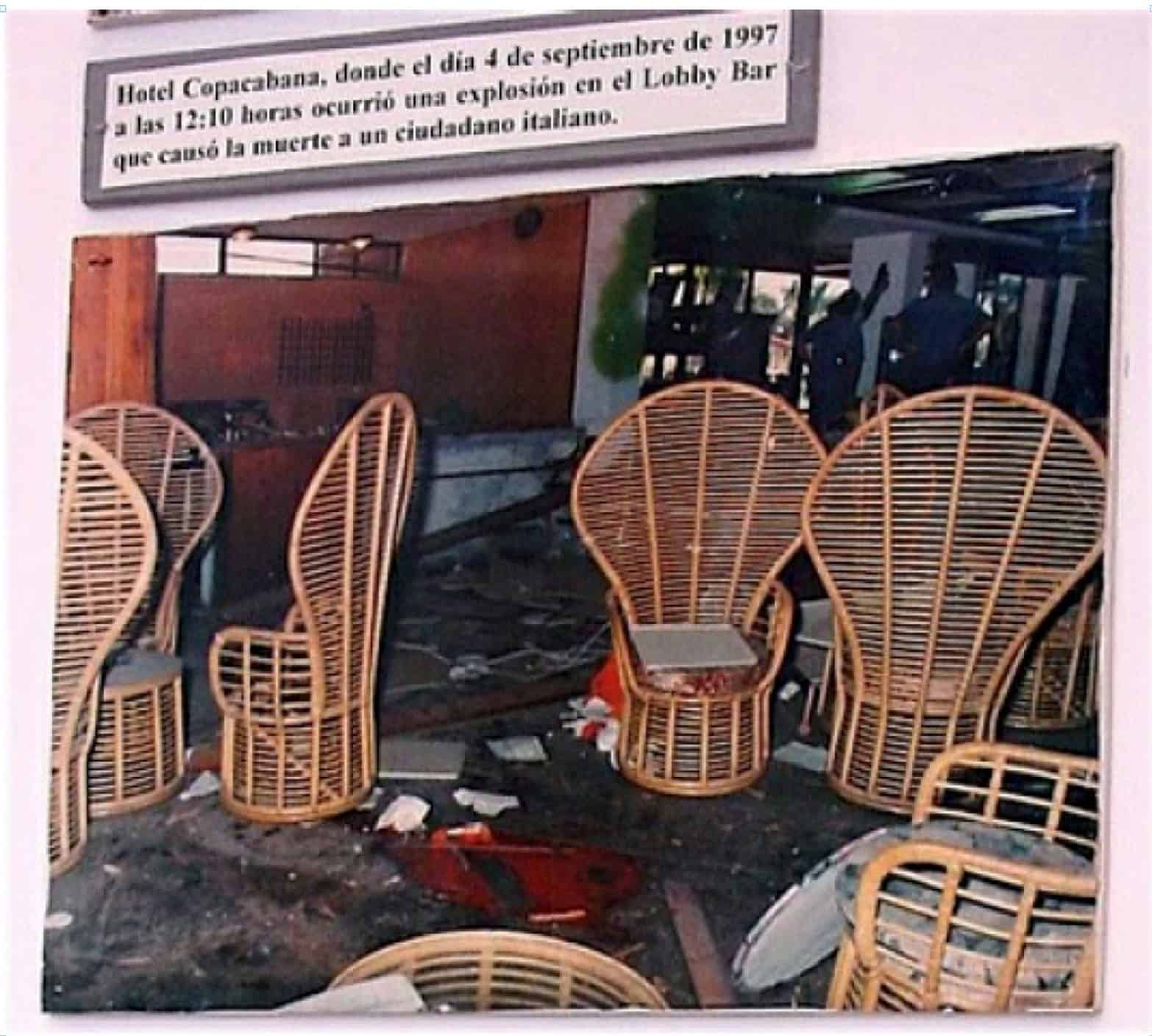
Blood-stained floor at Copacabana following the explosion. September 4, 1997.
Havana
September 4, 1997
10:30 a.m.
“Bucanero.” The olive-skinned young man could have been any tourist in Havana. Raúl Ernesto Cruz León, a 26-year-old Salvadoran, was casually dressed in yellow polo shirt, shorts, sandals and a tan baseball cap. He carried a small blue backpack slung over his shoulder. To the bartender in the lobby bar of the Copacabana Hotel in the city’s Miramar district, Cruz León would certainly have seemed unremarkable. The waiter nodded, turned and went to the fridge to get the tourist his beer.
Cruz León’s family and friends back in San Salvador also assumed he was vacationing. They’d been surprised in early July when he had unexpectedly announced his intention to travel to Havana the first time. They’d never heard him mention Cuba before. He told them a friend had won a Cuban vacation but couldn’t go. The man had sold Cruz León his ticket at a bargain price.
That first trip appeared to have had a profound effect. Cruz León was so taken with Cuba’s beauty, he told his brother William, he planned to go back again as soon as he could afford it.
Even the bombs didn’t deter him. His brother had seen TV news reports about bombs going off in Havana hotels and asked Raúl about them. Raúl admitted he’d witnessed one attack himself. He’d been frightened like the rest of the tourists, he told his brother, but not so badly he wouldn’t go back.
Cruz León didn’t tell his brother everything he knew about the explosions, or explain why he wasn’t afraid. Cruz León had planted the bombs at both the Hotel Nacional and the nearby Hotel Capri.
It had been remarkably easy to do. Just as his friend “Gordito” had told him it would be. Although he’d been strip-searched at Havana’s José Martí airport, the security guards didn’t check his shoes—even after Cruz Léon asked, “My shoes too?” So they hadn’t discovered the C-4 concealed in them. [1] They hadn’t twigged to the real purpose of some of the other items in his luggage either. The clocks and pocket calculators he claimed were gifts for Cuban friends, for example.
On July 12, Cruz León had armed the first bomb inside a washroom at the Capri, placed it beside a couch in the hotel lobby. He then calmly walked two blocks down Calle 19 toward the Malecón and up the long, palm-lined entrance drive to the Hotel Nacional.
Cruz León placed his second timed-to-explode bomb under a couch in the National’s lobby near the public telephones and was about to leave when he noticed a tourist sit down on the couch. “There’s a call for you at the desk,” he improvised. He didn’t want to hurt anyone. He’d told Gordito that. Gordito didn’t seem to care. Just make some noise, he said. Create some confusion.
It had worked. Cruz León retreated to a safe corner of the lobby to watch the bomb explode and savor the noise and confusion that followed. He’d even mingled with a group of hotel guests—one of them perhaps the US Interest Section employee who’d telephoned Vicki Huddleston at Ricardo Alarcón’s office— joining them in their horrified recollections of what they’d all just witnessed and then slipping off into the Havana sunshine after the police arrived.
Gordito would have been proud.
Gordito’s real name was Francisco Antonio Chávez Abarca. He and Cruz León had become friends through the San Salvador car rental agency where Cruz León sometimes worked. Chávez Abarca, one of the agency’s big-spending customers, often rented four-wheel-drive luxury vehicles—and not just because he fancied them. Chávez Abarca’s father, a notorious local gangster, would copy the documents from the cars his son rented and use them to turn stolen cars of the same make and model into apparently legal ones he could re-sell.
Gordito’s father—or, more accurately, one of his father’s friends—had been the person most responsible for the fact Cruz León was now sitting at the bar in the lobby of the Copacabana.
“Gracias,” Cruz León said as the bartender placed the beer in front of him. He took a sip, put down the glass, walked through the lobby to the washroom.
Gordito’s father’s friend was Luis Posada. During the mid-eighties, when Posada was part of the supply train ferrying weapons to the Nicaraguan Contras, Gordito’s father had been one of his local arms suppliers. Last year, after Posada concocted his scheme to hire Central American mercenaries to bomb Havana hotels, he discussed it with his friend, who, in turn, discussed it with his son.
Gordito himself carried the first bombs into Cuba. The bomb in the bathroom next to the Aché discotheque? That was his. So was the bomb police discovered—and disarmed—a few weeks later in a planter near an elevator at the Melia Cohiba hotel,[2] and the bomb/soccer ball the young chess players had discovered.
Nothing to it, Gordito had reassured Cruz León when he recruited him for “a little job.” When Gordito told him he’d be planting bombs in Cuban hotels, Cruz León figured Gordito must have had a beef with some hotel owner. Not that the reason mattered all that much.
Cruz León needed the money. He was so deeply in debt his mother had had to mortgage her jewelry store to help him get out from under. He couldn’t. In December 1996, he’d almost lost his car to the repo man and he was now three months behind on payments for his colour TV.
But debt wasn’t his only motivator. “I thought of that movie, The Specialist, with Sylvester Stallone and Sharon Stone,” Cruz León would remember later. “That guy planted a bomb, and he ended up a hero.”
Cruz León loved the “rush of adrenalin” that came with danger. He had grown up in the middle of a decade-long bloody civil war between El Salvador’s U.S.-backed military rulers and leftist insurgents that left 75,000 of his countrymen dead. But his own attempts at military adventure inevitably turned into misadventures. He enrolled in military school twice, and dropped out each time. He signed up for a civilian parachuting course, but that came to a crashing end—literally—when he broke his leg on his third jump.
After he recovered, Cruz León landed a less dangerous job providing security on the sets of television programs being filmed around San Salvador. “Mostly,” his sister would recall, “he just kept girls from bothering the stars.” His easygoing nature brought him to the attention of a local promoter who hired him to chauffeur visiting performers around town. Although those gigs were fun—he’d amassed a collection of photos of himself with one-named Latin American singing sensations like Selena and Thalia—Cruz León was always looking for the bigger score.
Gordito offered that. When he recruited him for his first Cuba bombing run, Gordito said he would take care of all the details: buying the airline tickets, arranging visas, fronting travel expense money. All Cruz León had to do was learn to assemble the bombs; he turned out to be very good at that, assembling an explosive device from “a small wad of plastic explosive, a detonator, a thin Casio alarm clock and a nine-volt battery”—in just over a minute. For every bomb Cruz León detonated, Gordito promised, he would earn $2,000 (U.S.).
After Cruz León returned from his first mission to Cuba, Gordito had paid him $3,000 and promised he would get the rest after his next trip. Cruz León was eager to return, and not just for the money. ‘‘I thought that I had accomplished a heroic mission,’’ he would say later. “I thought it was an action against the evil.’’
On August 31, Gordito had driven Cruz León to the airport again and helped him carry a heavy box to the check-in counter. Cruz León told the agent it contained a television set he was bringing to a friend in Cuba. The box did contain a TV, but it wasn’t for a friend, and the inside was lined with C-4.
Now, inside the washroom at the Copacabana, Cruz León reached into his backpack, removed one of four plastic bags, connected the pieces of a bomb, set the timer and returned to the lobby. He paused beside a standing metal cylinder ashtray and gently placed the bag inside, then he returned to the bar. He looked at his watch. He had more than enough time to finish his beer.
Havana
September 4, 1997
11:00 a.m.
Fabio Di Celmo was apologetic. Another day perhaps, he suggested into the telephone. The person at the other end of the line was a representative of Biconsa, a division of Cuba’s Ministry of Domestic Trade with whom he hoped to make a deal. But not today. Their appointment was for noon, but Fabio had a more pressing commitment. Enrico and Francesca, his best “buddies” from his school days in Italy, had honeymooned in Cuba and were flying home this afternoon. Fabio, who’d suggested the honeymoon destination, had promised to treat them to one final lunch before they left.
Perhaps, Fabio suggested into the phone, he could meet with the Biconsa representative next week. He really did want to do some business. Of course. Yes, yes, that would be fine.
Fabio hung up, explained the new arrangements to his father. Giustino nodded. While Fabio met with his friends in the lobby bar at the Copacabana, Giustino would return to his room on the fourth floor to rest. Perhaps he’d join them for a drink later.
Fabio was feeling good. About himself, about business, about life. At 32, he sensed he was finally emerging from his father’s business shadow. Although Gisutino Di Celmo was 77 years old, he still cast a long shadow.
Giustino had been—still was—a natural-born salesman, a larger-than-life figure who could peddle anything to anyone. After World War II, Giustino left war-ravaged Italy for a better life in the new world. He and his wife Ora settled in Argentina where Giustino could weave his selling magic while Ora raised their two young children, Livio and Titania.
But Giustino’s friendships with anti-government union leaders soon brought him into conflict with Argentinean strongman Juan Peron. After some friends were murdered, Giustino packed up the family and returned to Italy.
Fabio—in Roman times, a name given to a “special person”—was born there in 1965.
From his base in Genoa, Giustino developed a thriving export business, selling much-needed furniture for hotels in outposts of the Soviet empire. In the early 1970s, he began travelling to Canada peddling stylish Italian jewelry in Montreal. In 1976—the year of the Montreal Olympics—the family became permanent Canadian residents, allowing them to spend part of the year in Montreal and part in Italy.
The collapse of the Soviet Union in the early 1990s threatened Giustino’s business, but he quickly parlayed an old friendship with the Czech Trade Minister into an introduction to Cuba’s Minister of Domestic Trade.
The loss of its Soviet benefactor had forced Cuba to turn to tourism to generate desperately needed revenues. Attracting visitors to the island meant building world-class resorts. And that, of course, meant a need for beds, furnishings, carpets, cleaning supplies, everything. Di Celmo was more than ready to supply those needs.
In 1992, Giustino and his youngest son Fabio flew to Havana to meet with Cuban Domestic Trade Minister Manuel Vila Sosa.[3] Fabio was impressed, he would tell his older brother Livio afterward, and not just by the fact the first thing Vila Sosa did was to pick up his cell phone and call Czechoslovakia to make sure the Di Celmos really were friends of the minister, but also because the minister, a colonel in the Cuban army, wore jeans and a T-shirt. Fabio was going to like doing business in Havana.
Fabio had joined his father in business after high school. At first, he’d just been his father’s assistant, listening and watching while Giustino spun his salesman’s web. Over time, Fabio had assumed more and more responsibility for finding the products they sold and for maintaining quality control over them.
Thanks to competitive prices, on-time deliveries and quality products, sales had been brisk. One of their first big jobs was a contract to supply Italian furniture and carpets at the Hotel Nacional. There always seemed to be more opportunities. Cuba, as Fabio liked to say, needed “everything.”
Recently, Fabio had finalized the first two contracts he’d negotiated completely on his own. One was for sewing machine needles. For some reason, no one in Cuba had been able to find a supplier for the machines. Fabio had.
The deal had been a personal breakthrough, Fabio explained to Livio two days before, because he’d accomplished it all by himself. Fabio tried to convince his brother—who was then living in Montreal and had just lost his own job with an airline—to abandon life as “an office rat” and come work with him in Cuba. “We’ll have fun together,” he’d said.
Fabio had clearly become enamored with life in Cuba. While he hadn’t been interested in politics in Italy or Canada, he developed such an obsession with the speeches of Fidel Castro his friends had begun to tease him about it. After watching Castro deliver one of his famously spellbinding three-hour orations, Fabio told friends he’d never heard anyone speak so passionately about anything. After that, he’d read every Fidel Castro speech he could find, and had even begun to read Cuban history.
Fabio also had a Chinese-Cuban girlfriend and there was talk he and his father might buy a condo in the Monte Carlo Palace, a proposed condominium project for foreigners in Havana’s Miramar district.
Since it had been impossible for foreigners to buy real estate in Havana when they’d begun coming to the city, Giustino, like many other outside entrepreneurs, had turned a room in the Copacabana into his local hotel room-headquarters.
He’d chosen the Copacabana, a Brazilian-themed waterfront hotel that had been among the first to be renovated in 1992, because he liked its tropical ambience, its friendly staff and convenient location. Although it nuzzled up against the Atlantic coast—its natural saltwater pool filled directly from the ocean—the hotel was still an easy commute to almost anywhere.
By 1997, he and Fabio were spending close to four months a year in Havana. That, in part, was a reflection of their success, but also of the nature of doing business in Cuba. Cuba was not like other countries, Fabio had confided to his brother; in Havana everything took twice as long. Giustino and Fabio began their daily sales calls at 8 o’clock each morning and scheduled meetings, one after the other, until noon. There were few formal meetings after lunch. That was just the Cuban way of doing business, Fabio explained.
Today, with their last meeting of the morning on hold, Fabio was eager to hear how Enrico and Francesca had enjoyed their honeymoon in Cuba. He’d already been talking with Enrico, who was worried about his bride. She’d become obsessed with an irrational fear something “bad” was going to happen to them in Cuba. Fabio would be happy today to remind her that she’d been wrong.
He turned the corner, saw Enrico and Francesca seated at the glassed-in lobby bar waiting for him. He made his way past the tan couches, the high-backed rattan chairs, the potted palms, a canister ashtray. It was time for a drink, a celebration.
Havana
September 4, 1997
11:40 a.m.
“Señor! Señor!” the boy shouted after the man in the yellow polo shirt, shorts, sandals and a tan baseball cap. “You left something.”
The boy, who was just eight years old, was visiting from Spain with his parents. They were staying at the Triton, another Havana beachfront hotel a kilometer from the Copacabana. This morning, the boy had been playing in the lobby with his babysitter when he noticed a man get up from a seat in the lobby, shrug his blue backpack over his shoulder and walk out of the hotel, leaving a small black notebook behind.
“Señor, señor,” he called again, but the man didn’t look back.
Havana
September 4, 1997
12:00 p.m.
Roberto Hernández Caballero and his team of State Security investigators were already on their way to the scene of the blast at the Copacabana when they received a second urgent call. There’d been another explosion just up the street at the Hotel Miramar.
Two bombs close together. Just like at the Capri and the Nacional. What did that mean? About the person—or persons—planting the bombs?
Hernández Caballero knew enough to know that the Cuban American National Foundation’s recent statement to the Miami press suggesting the bombs were signs of some sort of internal rebellion was self-serving claptrap. It was far more likely CANF itself was behind the whole thing.
But Hernández Caballero knew investigations started at the bottom. In order to find out who was behind the bombs, he would first have to figure out who was planting them.
In the four months since the Aché explosion, four more had gone off and another had been discovered and defused. Two weeks ago, the most recent explosion occurred at the Sol Palmeras, a hotel in the resort area of Varadero. It was the first blast outside Havana, but it was still clearly targeted at the tourist industry. Was that bombing connected to the others?
In June, immigration officials arrested a Florida woman who claimed she’d come to Cuba to visit her brother. Authorities found traces of C-4 in her handbag, but hadn’t been able to connect it to any of the bombings.
Then in late July, police had responded to a report of an explosion in the highway tunnel leading into downtown Havana. It turned out to have been a false alarm—just a stupid German tourist setting off a firecracker—but even that had ratcheted up tensions in a city wracked by rumor.
Cuban authorities weren’t saying much publicly about the bombings. At first they denied they’d even happened. When the blasts at the Capri and Nacional forced them to acknowledge the obvious, officials did their best to minimize their significance. And no wonder. Would tourists come to Cuba if they thought there was a chance they’d be blown to bits?
So far, luckily, none had. But…
Another urgent call. Another explosion. This one a little further up the street from the first two. At the Triton. Hernández decided he would go to the Triton while the rest of his team fanned out to the Copacabana and the Chateau Miramar. It was going to be a long day.
Havana
September 4,
12:30 p.m.
Fabio dead? How could that be?
Giustino had been resting in his hotel room when he’d heard a deafening noise from somewhere below. A few minutes later, the receptionist telephoned him urgently from the hotel lobby. There’d been an explosion. His son had been wounded. He was being whisked by ambulance to the Clínica Central Cira García, the closest hospital.
Giustino rushed downstairs, past the shattered remains of the lobby bar past the overturned furniture, past the spot where the still wet puddle of his son’s bright-red blood stained the dark green carpet.
The journey to the hospital was a blur, the news there as unexpected as it was incomprehensible.
Fabio was dead, the doctor explained. He had died almost instantly, killed by a sharp piece of shrapnel from the blast. The projectile had ripped into his throat, slicing a major artery.
Havana
September 4, 1997
5:30 p.m.
It had been a good day. Four bombs. At $2,000 a bomb, that was $8,000. Not to forget the thousand Gordito owed him from the last trip. Cruz León would be able to pay off his debts and have plenty left over for other, better things.
He should call his girlfriend, Yohana, in San Salvador. Tell her… not the truth, of course. She didn’t need to know what he was really doing in Havana. Just that he was happy, having a good vacation. Perhaps next time she could come with him… He had called her three nights ago to let her know he’d arrived safely. “Tell mama I’m fine,” he’d said, “and I’ll call back Wednesday or Thursday.” It was already Thursday. He’d better call. He’d been dating Yohana Flores for 10 years. Maybe it was time to—
It had been so easy. After planting the first bomb in the ashtray at the Copacabana, Cruz León had walked 300 meters up First Avenue to the Miramar, another oceanfront hotel, placed the second plastic bag behind some furniture in the lobby and then did the same a few minutes later in Hotel Triton 500 meters along. After his initial experience in July, Cruz Léon decided he liked seeing and hearing the results of his handiwork so much he would plant these explosives in close-to-each-other hotels too, and he timed the detonations so he could still be in the neighborhood when they went off.
By the time he made his way back to the Copacabana, the first bomb had already exploded. The scene was pandemonium. Some journalists, foreign he guessed, had tried to quiz him about what he’d seen. “No español, no español,” he’d answered. But they persisted, asking him again in French and English. He kept shrugging his shoulders as he walked quickly away. The first police officers had already arrived with their sniffer dogs; no need to stick around for that. Not that there was any way anyone could connect the bombs to him. He was just another nameless tourist.
Like other nameless tourists, Cruz León enjoyed a late lunch that afternoon at a rooftop table at La Bodeguita del Medio, the famous, funky bar and restaurant in old Havana where Ernest Hemingway had once imbibed more than his share of mojitos. Cruz León saw Hemingway’s signed, framed declaration—“My mojito in La Bodeguita; my daiquiri in El Floridita”—on the wall behind the bar, admired the photos, signatures and initials that the famous (Gabriel García Márquez, Pablo Neruda, Salvador Allende) and the unknown had scrawled on or carved into the restaurant’s walls as mementoes of their visits.
Cruz León didn’t write his name anywhere, but he did leave something behind so people would know he’d been there. After he finished his meal, he reached into his backpack, took out his last plastic bag containing yet another bomb, stealthily armed its timer for later that night and slipped it between a wall and a restaurant freezer.
Then he left the restaurant and hired a bicycle taxi for the six-block trek back to the Hotel Plaza. The bici-taxi driver couldn’t help but notice when his passenger tossed a calculator into the street as he drove.
Like the Ambos Mundos, where Cruz León had stayed in July, the Plaza was an upscale historic hotel in the tourist heart of old Havana. The hotel was conveniently close to all of old Havana’s attractions: the Museo de Bellas Artes, the Museo de la Revolución, the stunning El Capitolio Nacional, which had been designed to look like the Capitol Building in Washington back in the days when Havana still aped American style. None of that especially interested Cruz León. But it was a sweltering September day. Perhaps he would take a stroll down the Prado, the equally famous, tree-shaded, marble-balustraded, terrazzo-floored central boulevard linking Parque Central to the Malecon and enjoy a little cooling breeze from the Bahia de la Habana.
But first he needed to call Yohana. He picked up the phone. Began to dial. As he did, the door to his room burst open. Police filled the hotel room. Raúl Ernesto Cruz León was no longer just another nameless tourist.
Montreal
September 4, 1997
7:30 p.m.
Livio Di Celmo knew he shouldn’t have said it, knew almost before the words had escaped his lips. But he couldn’t help himself. His brother had just been murdered.
The reporter from Montreal’s Le Devoir had reached him while he was still packing for the flight to Havana. Who do you think is responsible for your brother’s death, the reporter asked?
Livio didn’t know. Not for sure. But he had his suspicions.
He couldn’t help but remember that day, less than a year ago, when he and his younger brother had driven from Montreal to Vermont for what was supposed to be a pleasure trip. Instead, guards at the border stopped them, ripped apart their car and questioned them for six hours. Why? For no better reason than that Fabio’s passport carried a commercial visa stamp from Cuba. After that, Fabio vowed he would never set foot in the U.S. again.
Livio also knew some Cuban Americans “hated their country,” that they would do anything to defeat its government.
Who did he think was his responsible for his brother’s death?
“The dogs of the CIA,” he told the reporter. And instantly regretted it. What did he really know?
It would turn out that he knew far more than he knew.
Havana
September 4, 1997
11 p.m.
As soon as he heard the description from a fellow employee, Nicolás Rodríguez Valdés, a bartender at La Bodeguita, realized the hotel bomber the police were searching for must be the same strange, nervous young man he’d served just a few hours earlier.
Rodríguez was a popular veteran bartender. “I make the best mojitos at La Bodeguita,” he would boast, then laugh loudly. “But don’t ask anyone else who works there, because they’d say the same thing.”
That afternoon, he’d been working the restaurant’s upper level. There were two dining rooms in the upper level, one large, the other small. Rodríguez remembered the man had specifically asked to sit in the smaller, empty room rather than in the larger area, which was crowded with tourists at the time. He’d been a “weird one,” Rodríguez remembered. Even before his food arrived, he had taken out a calculator and seemed to be adding up the bill. After he served him, Rodríguez noted, he barely touched his food. Rodríguez assumed the young man must not be feeling well. “I offered him a liqueur to maybe settle his stomach,” Rodríguez would explain later. “Afterwards, he went to the bathroom and I could hear him throwing up. I attended to him, took care of him and did my best to try and make him feel better.”
Back in the restaurant, the grateful young man took out his camera and asked if he could take a picture of the two of them together. He set the camera’s controls to automatic, snapped his photo and then left.
Rodríguez wouldn’t have thought any more of it except that, a few hours later, police circulated a description of the man allegedly responsible for the bombs at the Copacabana and other hotels earlier that day.
Rodríguez immediately informed his manager, who also remembered the man. After learning investigators had taken someone into custody, the manager and another co-worker hurried to police headquarters to see if they could identify him.
Rodríguez remained behind. He closed the restaurant’s upper level, urging diners to move downstairs into the main bar area to continue drinking. That accomplished, he headed back upstairs to shutter the drinks’ area and complete his day’s paperwork “when suddenly—boom!!—I heard the explosion.”
Cruz Léon’s bomb ripped through La Bodeguita’s upstairs, blowing holes in the freezer and the wall where the device had been planted, destroying a nearby showcase filled with souvenirs, shattering the bar’s second-floor windows and ripping a gaping hole in the floor big enough that the table where Cruz Léon had been sitting fell through on to a group of four Mexicans dining below.
Rodríguez, who’d been just a few meters from the freezer when the device detonated, couldn’t see anything for the smoke and dust, couldn’t hear a sound. His ears had been blown out by the concussion.[1] “I had no idea what was going on and I was afraid that there might be another bomb. So I jumped over the bar and made my way down the stairs… It was mass confusion… People were screaming and crying and trying to get out as fast as they could. This is a small bar, and the door is narrow, so people were pushing and shoving to get out. It was total panic.”
Luckily—thanks to the fact Rodríguez had closed the upstairs section, thanks also to the fact also Cruz Léon had not chosen to place his bomb in the main bar area—no one was seriously hurt. But the reality, as everyone would quickly realize, was that Raúl Ernesto Cruz Léon had kept his last deadly ticking time bomb a secret while he confessed to everything else.
Havana
|September 4, 1997
11:30 p.m.
It hadn’t taken the police any time at all to get Raúl Cruz León to start talking. About Gordito, about how much Gordito was paying him, about how easy it had been to plant the bombs… But he’d kept news about La Bodeguita to himself.
The connections that led them to Room 314 at the Plaza had begun with the black notebook Cruz León left behind on the lobby table at the Triton. The boy’s babysitter gave investigators a detailed description of the man she’d seen walking away from her charge: a man in his mid-twenties wearing shorts, a polo shirt, baseball cap and sneakers and carrying a blue baseball cap. Her description matched those given by eye-witnesses to the earlier incidents at the Nacional and the Capri. Within the hour, police had distributed sketches of their suspect all over Havana. More witnesses began coming forward, including employees from the Bodeguita, as well as the bici-taxi driver who remembered picking up a strangely behaving young man near the Bodeguita and delivering him to the Plaza. From there, it was a simple matter of connecting Cruz Léon to his room.
In the room, police discovered electrical cables and tools as well as a schematic design of a bomb, along with a list of 12 hotels and restaurants that could serve as future targets. They also found traces of C-4 in Cruz Léon’s backpack, on his night table, in the room safe, on his clothing and under his fingernails. (Later, when they checked out the hotel room where he’d stayed during his first trip in July, they found traces of C-4 in its room safe too.)
They were still questioning Cruz León at 11 p.m. when the bomb he’d planted at the Bodeguita del Medio finally went off.
Cruz León explained he didn’t say anything about it in advance because he hoped they would assume someone else was responsible since he was already under arrest. He was wrong about that too.
[1] Rodríguez suffered permanent loss of hearing in his right ear, and remained off work for a month. “But more than the physical damage, something like this creates emotional damage,” he later told author Keith Bolender. “Every time I see someone with a package, I react to it. And every day, tourists bring in packages. Many times tourists come in and leave packages. They forget them. Every time that happens, I feel it again, in the pit of my stomach, that same fear. All the time.”
[1] After they’d served their purpose, Cruz Léon gave the shoes to a Cuban he’d met on the island. After police arrested Cruz Léon, they recovered the shoes and tested them. They discovered traces of C-4 in the heel.
[2] According to a report Cuban State Security handed over to the FBI in June 1998, Chavez Ararca may also have been responsible for the bombing of a Cuban travel agency in Mexico City on May 25, 1997. “Available information” shows he was in the city from May 22-25. After he was arrested in 2010, he confessed to setting that bomb too.
[3] Three years later, Vila Sosa was ousted from his job over corruption allegations.
Excerpted from What Lies Across the Water: The Real Story of the Cuban Five. (Fernwood Publishing, 2013)


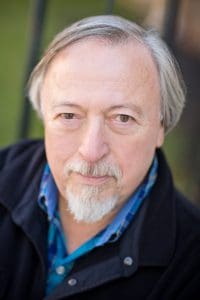 STEPHEN KIMBER, a Professor of Journalism at the University of King's College in Halifax and co-founder of its MFA in Creative Nonfiction Program, is an award-winning writer, editor and broadcaster. He is the author of two novels and eight non-fiction books. Buy his books

