
During my research for my 2009 book, IWK: A Century of Caring for Families (Nimbus), I interviewed Dr. John Crocker, a pediatric nephrologist at the Izaak Walton Killam Health Centre in Halifax.
Dr. Crocker died on October 26, 2016
Dr. Crocker could be a cantankerous character — he eventually sued the hospital and the province for breach of promise for not hiring a third kidney specialist to share the hospital’s workload — but he was obsessively devoted to his work, and to his young patients.
He played a key role in one of the book’s case studies, the poignant story below of Michael Young, a young boy with an extremely rare congenital kidney disease.
__
“Remember when you said about coming in and doing a ‘little volunteering,’” Liz Crocker began lightly, tentatively.
Carol Young remembered. She and her husband John had invited their friends, the Crockers — Liz and her husband Brian, John’s law partner—over to their home for a pleasant dinner a few nights before. Carol knew Liz was involved with something called the Child Life Department at the Izaak Walton Killam Hospital but she didn’t know what that actually meant, so she’d asked Liz to tell her more about what she did.
What Liz said that caught Carol’s attention was a reference to the hospital’s—and her — desperate need for volunteers who could spend time with kids whose parents couldn’t be with them during their hospital stays.
Carol thought, I can do that. It was the fall of 1977. She’d just recently quit her job as an organizer for Nova Scotia’s Liberal Party with no clear plan of what to do next. At the end of the evening, she volunteered. “If you need someone,” she told Liz, “just give me a call.”
And now Liz had done just that. “I’ve just received a consult of a child who does need some special visiting,” Liz explained into the telephone. “But it may not be quite what you had in mind. He’s a little baby—”
“Oh, I’m not sure about babies.” Carol had been imagining an older child, someone she could talk to, a person.
“Well, he’s not just a baby,” Liz continued. “He’s got a lot of problems. A congenital disease. He’s also blind. And probably more—he may be deaf and retarded too.”
“Oh.”
“His origins are—well they’re complicated. He needs a lot of love because he’s been significantly deprived of love and attention and stimulation to this point. But all that would be involved from you, if you’re willing, is a lot of holding and cuddling and rocking and tickling and singing, you know, just a lot of soft, warm stuff.”
“I’m sorry Liz,” Carol replied, too quickly. “I don’t think I could handle all that. Let me think about it but, no, I just don’t think this is for me.”
***
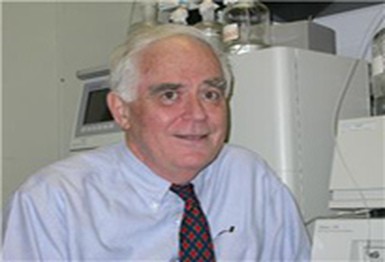
Dr. John Crocker
“Complicated” didn’t begin to describe Baby Charles’s[1] history. It had begun three months earlier with a call to Dr. John Crocker, the head of the IWK’s renal unit (and no relation to Liz), from a doctor in Saint John, New Brunswick. “What’s the kidney lesion that can give you a serum chloride level of 46?” she wanted to know.
The short answer was that there wasn’t one. The longer answer would be found in a crumpled sheaf of papers in Crocker’s wastebasket.
The doctor walked Crocker through her notes on her infant patient. Born six weeks earlier at between four and eight weeks premature… birth weight 1720 grams… jaundiced… phototherapy… discharged… ate ravenously… produced green and slimy bowel movements every half hour… increasingly irritable… started vomiting… readmitted three weeks later… anemic… sodium and chloride levels half of normal. She checked off the checklist of all the various and sundry tests (X-rays or abdominal obstructions, sweat tests for cystic fibrosis) she’d ordered that had failed to find a cause. As she did, Crocker rummaged through the papers in his trash.
As Atlantic Canada’s best known specialist in children’s kidney diseases, Crocker spent hours every day poring over the latest scientific literature, in part so he could answer questions like the one from the doctor. He maintained two huge, well-stocked personal medical libraries, one in his office and the other at home. His reprint files included more than 100,000 articles from medical journals from all over the world. Each week, he added another 40-60 articles to his collection, culled from the two to three hours’ worth of speed reading he did each morning before dawn in search of useful tidbits of information for his research.
Which is why he was now on his hands and knees looking for — here it was! —“The Renal Lesion in Congenital Chloride Diarrhea.” It was a reprint from The Journal of Pediatrics he’d scanned and then tossed a few hours before because it didn’t have seem to have anything to do with to do with his current research into the role chloride plays in polycystic kidney disease. In this case, the disease was also so rare — less than two dozen reported cases in the entire world — he couldn’t imagine ever encountering it.
And yet…
“My guess,” he told the doctor confidently, “is that you have a case of congenital chloride-losing diarrhea on your hands.”
The best approach, Crocker and the baby’s doctor quickly agreed, was to transfer Baby Charles from Saint John to the IWK, which would be far better equipped to diagnose and deal with such a rare disorder.
***

Dr. Phil Bagnell
Congenital Chloride Diarrhea — “an inherited defect of active intestinal chloride transport, which results in a large wastage of electrolytes and water… a persistent watery diarrhea from the first day of life” — is an extremely rare condition. The closer the genetic relationship between the mother and father, the more likely it is their offspring will inherit the problem.
Phil Bagnell, then the IWK’s gastro-intestinal specialist, quickly confirmed John Crocker’s initial diagnosis and became Baby Charles’s primary doctor. He met with the baby’s family, but they couldn’t—or didn’t want to—assume responsibility for his care.
Bagnell immediately understood the medical — and non-medical — implications of that. This was a baby who would require constant care and medical monitoring to keep his electrolytes in balance. To make matters worse, he was blind, probably as the result of seizures he’d experienced. The small circumference of his head and his lack of gross motor skills suggested he would be developmentally delayed. Given all those problems, he wasn’t a likely candidate for adoption. That meant he might end up living what life he had in a hospital or, worse, on a ward in an institution too far from the IWK to get the care he would almost certainly continue to need.
Even as Bagnell did his doctorly best to stabilize Baby Charles’s erratic electrolytes, he couldn’t help but ask himself: what, in the end, was he saving this child for?
That was one reason why Bagnell had approached Liz Crocker, the head of the hospital’s Child Life Department. Bagnell knew Crocker had begun a program to train hospital volunteers to interact with children who needed way more time and personal attention than regular volunteers could give. Bagnell knew Baby Charles would need all the special help he could get if he was to make the most of the bad hand he’d been dealt.
Could Liz Crocker help, he wanted to know?
It turned out she already had someone in mind. “As soon as I got the consult,” Crocker recalls today, “I thought of my conversation with Carol.”
***
That was dumb. Almost as soon as she’d hung up the telephone, Carol Young regretted her too-hasty dismissal of Liz’s request. Why shouldn’t I be able to handle a “complicated” baby? She quickly picked up the telephone again, called Crocker back.
“Of course I’ll do it.”
“I don’t usually plan things out in my life,” Carole would say later. “They just happen.”
What happened was Baby Charles. And magic.
***
“He’s such a tiny waif.” He was much smaller than Carol had expected. Six pounds, Donna Richards, the head nurse on 4 West, told her. Carol was afraid to touch him. She did, of course. But when she picked him up, he became rigid, like a brick in her arms. She could see that the sides of his head had been shaved—they’d run out of other places to insert IVs, Richards explained — but she also noticed the strawberry blond colour of what was left of his hair and the clear blue of his eyes. He was going to be a handsome young boy, she thought. She drew him closer and rocked him gently.
When he first noticed Carol on the ward with Baby Charles, Phil Bagnell didn’t take much notice. “I could see that she was a warm person and she was relating well, but I never really gave it more thought than that. But then Donna Richards and some of other nurses on the unit began to talk about her and tell me what a difference she was making with this child. And then I began to see it too. Medically—not in terms of his diarrhea, of course, but in terms of his development—it became clear that Carol Young was making a difference.”
Carol began to spend more and more time with the baby, marveling at his progress, spending all of her days with him. “On fine days,” Clare McDade, the secretary in the Volunteer department, would recall, “Carol would come down with the baby in a stroller to get her coat and take him out for a walk. While she was getting her coat, I used to take him around to the different offices. Whenever people spoke to him, his arms and legs would go like crazy; he was so happy. There was a play garden outside and Carol used to take him for a walk out there. Despite all of his problems,” McDade marvels,” Carol treated him like a normal baby. She was always upbeat with him.”
At some point, Carol started taking Baby Charles home with her for weekends. Which is how her husband John got hooked too. At first he wasn’t sure he was ready for the challenge. But Baby Charles quickly won him over. “He responded to even little things like music, or the sound of something tinkling,” recalls John. “He had this very infectious laugh if you tickled him or made a funny sound—like gargling. The first time he heard gargling he went into hysterics. Whenever you did things, even simple things, he responded. And the more you did, the more he responded… It was very exciting.”
One step led to another, and another, and eventually Baby Charles legally became Michael Philip—in honour of Phil Bagnell—Young.
On the day the adoption became official, John, who is far from a demonstrative man, telephoned Bagnell to give him the news.
“Phil, it’s John. I’m just sitting here in my office about to sign the adoption paper to make Michael ours. “
“Yeah?”
“I just wanted you to know that that little guy is the greatest thing to happen to our lives.”
***
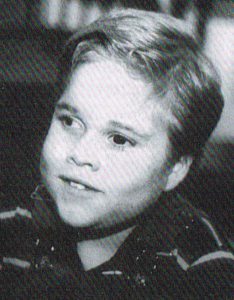
Michael Young
Adoption was the beginning of Michael’s real life, a life with family, friends and some hope of a future — or at least of a present.
“I’ll never forget the day he took his first step,” Carol says, sounding like EveryMom. “If I could have captured the look on his face—surprise, glee. It was just magical. He pushed himself away from the refrigerator door and suddenly he was standing alone. He wasn’t sure what to do. He took a few steps and then he stopped.”
But not for long. After Michael began to walk—thanks to his difficult beginnings, he didn’t finally begin walking independently until he was 27 months old—Carol rigged up a rope on a pulley, which she attached to a clothesline in their large, hedged-in Dartmouth backyard. The system allowed Michael to “go roaring up and down” the yard, experiencing the outdoors with some measure of independence but in relative safety. Carol also installed a backyard swing set for Michael who especially enjoyed the sensation of being pushed through the air. Later, he would learn to identify the differences at the various playgrounds where his parents took him to play.
“You don’t think about sounds usually,” John explains, “but being around Michael made you take notice—sounds really excited him: the rain on the porch roof, the sound rocks made when you threw them in the water, the waves on the beach.”
Carol’s brother, a musician, gave Michael a small Casio portable keyboard as a gift. Michael lugged it everywhere he went, learning almost instinctively to play and amusing everyone with the songs about his life he would improvise as he played.
John Parsons, his teacher at Sir Frederick Fraser School in Halifax, a school for the visually impaired, recalls that Michael “had this ear… If it was something he heard on the radio or TV, he could just go to the piano and play it in that particular key. And then harmonize it in the most interesting and fascinating way, in a different way. He had a strong personality that was almost reflected in his playing. The thing I found about his music was there was a certain therapeutic side to it, a freedom to it. When he was riding high with his keyboard, he seemed to be in his best learning mode… When things were right in his environment, he would go off on these wonderful improvisatory exposés. He was an entertainer.”
John Young and Michael enjoyed all the usual father-son activities, often with a twist to accommodate Michael’s blindness. After the family moved to Halifax, they would often kick around a ball with a bell inside at the nearby Dalhousie University field. “I’d roll the ball and I’d yell, ‘Here it comes, it’s coming to you, it’s going to be there, 3-2-1, there it is,’” John says. “And then he’d kick it back to me and he’d laugh. He had this great laugh.
“Holidays had their rituals too,” adds John, who would take Michael trick-or-treating each Halloween. One year Michael was an Ewok from Star Wars; the next a ghost in a white sheet. He told everyone he was invisible. “We’d go to the door,” John recalls, “and I’d tell him, ‘Here they come! Here they come! They’re opening the door, and he’d yell, ‘Boo!’”
At Christmas, Carol parceled out Michael’s gifts one day at a time to ”keep him from becoming over-stimulated.” On Christmas morning, she would tie a string from Michael’s bed all the way down the stairs and attach it to Michael’s major gift.
One year, Michael—like millions of other children that Christmas—wanted a Cabbage Patch doll. Yang, his Cabbage Patch doll—like much else in Michael’s life—became a symbol of both just how “normal” his life had become and, at the same time, just how unusual it continued to be. During his still all-too-frequent visits to the hospital, Yang became Michael’s constant companion. Yang would endure most of the same medical procedures—including having needles—that Michael had to put up with. And Michael would chew on Yang’s arms for comfort whenever he himself was being poked or prodded. “After a while, “ says Carol, “Yang looked like a Thalidomide Cabbage Patch.” She would frequently have to sew Michael’s friend back to health.
Music too was also part of Michael’s coping with what he was going through. Michael would often make up songs to describe his hospital experiences: “The doctor put a catheter in my penis and it hurts so much,” he’d sing.
As Michael’s condition worsened, his music changed, mimicking his own sickly form, eventually emerging in the form of slow funeral dirges. Nurses often had to ask him to stop, finding his playing too sad to listen to.
But even within the hospital, Michael usually seemed to find a way to endear himself to everyone he met with his endless enthusiasm and occasionally offbeat sense of humour.
“I remember one morning Michael arrived at the dialysis unit early and one of the nurses was behind a screen in the unit changing into her uniform,” says Paul Grimm, a pediatric nephrology resident who frequently treated Michael. “She knew Michael was blind, of course, but she said, ‘I am going to change my clothes now, Michael. Don’t look!’ And Michael suddenly opened his eyes really wide and you could see him stretching, trying to see. The nurse shrieked. And Val [Dorcas, a nurse in the unit] said, ”You know, I wonder if Michael’s been fooling us all these years.”
“One night, I remember he woke up at two in the morning and he couldn’t seem to settle down,” adds Kim Grimm, Paul’s wife, who was a nurse in the unit. “I went to try to calm him down. And he started doing these impersonations of people in the hospital. He was so funny, he knew what people would say and he would have the inflections down perfectly, sounding just like the person. He had me in the room, laughing and then some of the other nurses came in—this is two o’clock in the morning, remember—and pretty soon, we were all listening to him doing all these different people. ‘And this is what Dr. Crocker says…’ ‘And this what Dr. Paul says: Good morning, sir…’ He must have done about 10 different people that night.”
***
December 16, 1981. John Crocker looked again at the results of the kidney biopsy on his desk in front of him. They confirmed his diagnosis. Michael Young was suffering from renal failure. Worse, the results indicated things were going to get even worse. They were not going to get better. “The biopsy told us there would be a continuous progression of the uremia,” Crocker explains. “It was not a static lesion; it was a moving lesion. That meant it wouldn’t get better.”
That night Carol called John, who was in Ottawa for a business meeting. “It was about eleven at night when I got back to the Chateau Laurier,” John recalls, “and they gave me the message Carol had called. When I called her back, she told me what they’d said.” He stops, thinks for a moment. “After I finished talking with Carol that night and I’d hung up, I remember thinking to myself, ’He’s going to die.’ That was my first thought. ‘He’s going to die…’ That was in many ways the most devastating day of my life. I can remember that day like it was yesterday.”
Michael was barely four years old.
***
Having been born with a disease so rare there were only 32 recorded cases in the whole world inevitably set the stage for Michael’s life — a life filled with seemingly never-ending hospital visits, emergency operations, dialysis and two failed kidney transplants.
But Michael was always far more than the sum of his condition. Carol made sure of that.
Carol gave up virtually all of her outside interests, and devoted herself totally to Michael’s care. “No matter what I was involved with, I would always have to tell people, ‘Well, I’ll do this but, if Michael gets sick, then I’m going to be gone, I’m going to be with him.’ But as he got sicker,” she adds,” it became harder even to get involved with other things at all.”
The only exception—and she made it largely because of Michael—was that she accepted an invitation to become a member of the Izaak Walton Killam Hospital’s Board of directors.[2]
It turned out to be an inspired invitation for the future of the IWK. At the time, John was on the Canadian Broadcasting Corporation’s board of directors, and Carol took advantage of that to engineer a deal between the hospital and the CBC. “One night in January or February of 1985,” Carol recalls, “we invited Liz Crocker and Bill Donovan [the CBC’s regional director at the time] to dinner, and we ended up discussing the idea of working together on a telethon to raise money for the hospital.”
Four months later, the first Maritime-wide IWK Telethon took place.
The day after that first telethon — on June 6, 1985 — Michael Young received his second kidney transplant.
“I always say it was the first miracle of the Miracle Network Telethon,” says Carol.
But, like Michael’s first transplant, the miracle turned out to be short lived.
***
In April 1986, the cardiologists who had tested Michael following some seizures discovered one more problem, a hypertrophic cardiomyopathy, or enlarging of his heart muscle. “We seemed to be losing ground with regard to his overall condition,” John Crocker would recall. “We were getting complication after complication. The heart was just one more. We were having to deal with multi-systems failure—kidney disease, heart disease, seizure disorder, multisystems… everything just going down the tubes.”
Crocker had pushed himself from the very beginning to help Michael survive. And not just for Michael. “The idea is what you are doing is pushing out at the envelope, extending life. My own belief is that if we don’t work on the bad ones, then moderates ones become more difficult. Then, if you don’t work on the moderate ones, it becomes the mild ones. If you don’t struggle with the really, really bad ones, you won’t be clued in enough to all the finesses. But if you work on the ones that look desperate, you pull 15 or 20 percent through, and your expertise is going to be a bit more subtle in the future.”
But Michael had begun having nightmares before dialysis. He had to have an internal shunt (for dialysis needles) inserted because in his agony he would tear the external ones out. Even with the internal ones, however, abscesses and infections grew around them. The doctors were running out of places to put the internal shunts.
“It got the point where you couldn’t find a positive light at the end of the tunnel,” Crocker admits. “There was no positive light. There was no light at all.”
Crocker had already talked with Carol and John about his own concerns. “I think that John was obviously certain that his boy had reached the end of his rope, that we were now torturing him and that it should be stopped,” Crocker recalls.
Yet somehow Michael came back from the edge of death, again and again.
But even he seemed to sense the end coming.
In early February 1989, during one of Michael’s last dialysis sessions, nurse Pat Waddel would recall an incident that happened “out of the blue. He was having a horrible day,” she says. “He just called me over and he took my hand and he said, ‘Patti, my mommy really loves me.’ That’s all he said. It was in the midst of a tirade. I could feel my eyes fill up. It was out of character for the day. It was like he knew what was going to happen and he wanted to just say it.”
On Wednesday, February 24, 1989, Carol called her father so he could talk to Michael in advance of a planned visit.
“I’ll be there to see you tomorrow,” he said.
“No grandpa,” Michael said to him. “You come today.”
Having lived so much of his life in the hospital, Michael’s family decided he would die at home with his family.
At 12:31 a.m. on February 26, 1989, Michael Phillip Young died.
Looked at from the perspective of a detached outsider, it might be easy to argue that Michael Phillip Young should probably never have been born; that he didn’t have a chance from the moment of his conception, that the life that followed was nothing more than an inevitably losing battle against unrelenting attacks from his own body; that caring for him consumed the lives of his adoptive parents for 11 years and for what?
But no one who knew Michael, or who knew about his life with Carol and John, could reach those kind of balance-sheet conclusions.
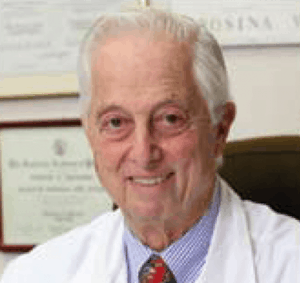
Dr. Richard Goldbloom
“Was it worth it?” Richard Goldbloom, who watched Michael’s life unfold as both a medical case and as family friend to John and Carol, rolls the question around in his mind. “It’s not ours to judge, of course, but, for me, I would say yes, absolutely, it was worth it. Michael’s life was special, and the relationship between Michael and his parents was special too.
“When you’re watching from the sidelines,” he adds, “you’d sometimes ask yourself, ‘Why are they punishing themselves this way?’ But then you’d see them together and you’d realized that each of them was the better for their relationship. And, in some way, so were the rest of us.”
Carol herself has no doubts. “Some people still say to me, ‘Oh, Michael was so lucky to have found you.’ But I always say, “No it’s not like that. We found each other.”
___
[1] For privacy reasons, the child’s name has been changed.
[2] Carol was a member of the IWK Children’s Hospital Board from 1982–1991 and a member of the IWK Children’s Hospital Foundation Board from 1987–l996. She was Chair of the Foundation from 1994–96.



 STEPHEN KIMBER, a Professor of Journalism at the University of King's College in Halifax and co-founder of its MFA in Creative Nonfiction Program, is an award-winning writer, editor and broadcaster. He is the author of two novels and eight non-fiction books. Buy his books

